Tyranny - Standard Edition includes the following:
- Base Game
- Ringtones: three notification tones and one ringtone
- Commander Edition Forum Icon (for Paradox Plaza only)
- Forum Avatars (for Paradox Plaza only)
In Tyranny, the grand war between good and evil is over – and the forces of evil...
Tyranny - Standard Edition includes the following:
- Base Game - Ringtones: three notification tones and one ringtone
- Commander Edition Forum Icon (for Paradox Plaza only)
- Forum Avatars (for Paradox Plaza only)
In Tyranny, the grand war between good and evil is over – and the forces of evil, led by Kyros the Overlord, have won. The Overlord’s merciless armies dominate the face of the world, and its denizens must find their new roles within the war-torn realm... even as discord begins to rumble among the ranks of Kyros’ most powerful Archons.
Players will experience the new world order under Overlord in a reactive role-playing game (RPG), interacting with the populace as a powerful Fatebinder in the Overlord’s forces -- roaming the lands to inspire loyalty or fear as they bring control to the last holdouts of the Tiers.
Branching, unique stories in an original setting: The battle between good and evil has already taken place, and evil stands victorious
Choices matter – make world-altering decisions with far-reaching consequence: As a Fatebinder in the Overlord’s army you wield a vast amount of power in the occupied lands of the Tiers. Will you use that to inspire stability and loyalty, will you be feared, or will you seek your own power?
Challenging, classic RPG combat: Tactical real-time-with-pause combat with new party-driven mechanics and modern presentation
A rich original setting: Not just another “hero’s journey” -- Tyranny turns the archetypal RPG story on its head and allows players to explore a new take on good and evil
By playing any game published by Paradox Interactive AB, you (i) agree to be bound by the User Agreement and (ii) confirm that you have read and understood the Privacy Policy.
Please Note: In order to access the Paradox Plaza Forum Icons and Avatars please use your unique serial key that can be found under My Account and redeemed at Paradox Plaza.
Recommended system requirements:
By playing any game published by Paradox Interactive AB, you (i) agree to be bound by the User Agreement and (ii) confirm that you have read and understood the Privacy Policy.
Please Note: In order to access the Paradox Plaza Forum Icons and Avatars please use your unique serial key that can be found under My Account and redeemed at Paradox Plaza.
Why buy on GOG.COM?
DRM FREE. No activation or online connection required to play.
I was pretty puzzled by the negative reviews on metacritic and now on gog too.
I would like to clear up some of these mentioned negative points from my point of view, to help out any unsure customers.
1: "This game is too short!"
Well... there are some reviewers who claim to have fiished the game within 10-18 hours. While I do believe this is possible, I don't believe you got the point of an RPG like that. I played 26 hours so far, and I am nowhere near the end. I am still in Act II and there are at least two more towers to go + some edicts to break (saw the achievements to break them all in one game so yeah, this must be possible).
To be honest, even as a textmonger I only read like 70% of the possible dialog... so you tell me you finished the whole game in 15 hours? Well, I call shannanigans (or you probably didn't read, that would be a shame).
2:"Bugridden mess!"
Hm, I had some minor bugs but only very few. Nowadays, this is top for a fresh release. Most of the "bugs" I read about abere simply design choices you need to adept, like fighting cooldowns and combohandling. Disengaging while battling your tank? Well.. I for one think this is clever enemy behaviour.
3:"Companion AI is a mess!"
To be honest, yes it can be from time to time. But remember Pillars or even BG AI scripts? Tey are way smarter in this game. Sure, they won't be as effective as controlled by you but... thats the whole point of the option to control them?
I am really annoyed by complaints that are either not entirely true or plain old lies. The game itself suffers from some strange design choices (I for one am not a fan of this characterartstyle, but this is no gamebreaker). Furthermore, the ammount of text compared to the extremely small maps will shock you. But after some time in game you will find yourself thinking: Ok, they cut down the useless strolling around giant maps, thats actually pretty nice.
If you want a rich story wich can be replayed three times at least, go for it.
Since the game has just been released, I obviously haven't been able to get through it entirely thus far, but for all you RPG fans (myself being one) I figured it could be helpful to know what this game is about in making a decision whether you should buy it or not. Hopefully, what I'm about to write will prove sufficient for you to make a more "informed" decision.
Lets start with the basics (You may skip these, two paragraphs, they're more to help you understand my judgement upon Tyranny and what I specifically took note on): I have a very specific definition of what an RPG is and not all computer games labelled as such fall into that category. To me, important aspects of an RPG are the ability to craft your own character (not necessary by character creation but by making ACTUAL choices in game), have at least SOME influence on the story that unfolds and AT LEAST decent writing (both storywise and while putting NPCs into the game).
To that end, the so-called JRPGies (RPGies originating in Japan) are a separate genre for me, since for the most part (with some exceptions) they are linear and not heavy on character creation (doesn't mean they're bad game mind you - just not what I call RPG). Similarly, hack & slash type games (Diablo being the prime example) are also a different category.
With that in mind, I'm pleased to say that, from what I saw, Tyranny DOES fall into my RPG category.
You start the game as, basically, every other RPG - by creating your own character. There are no races nor classes per say, but you do get to choose your gender and origins (somewhat similarly to the first "Dragon Age" and "Mass Effect"). The origins are presented to you in written form and from the 8 you are given to choose from, EACH will affect your options in-game; for example - if you choose a Diplomat origin, you're more likely to implement diplomacy in your conversations (duh), while being a soldier gives you more knowledge of the battlefield. Often these new conversation options are more than cosmetic.
The origins themselves also determine your playstyle somewhat (think of them as equivalent of classes). I would venture that there are two origins that correspond to the most wide-spread classes in "common" RPGies: fighter (meele warrior), ranger (ranged warrior), rogue (a stealthy individual) and a mage (for spells).
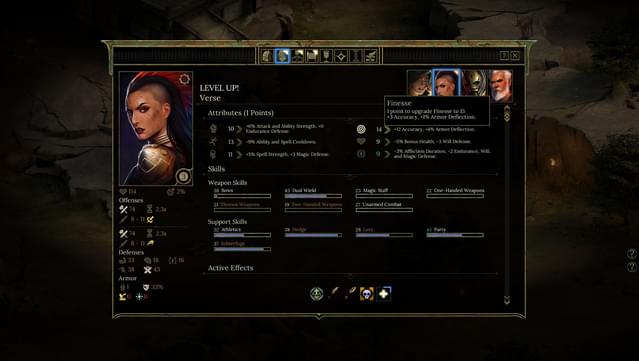
After you choose your origins, you adjust your atributes and skills. There are 6 attributes overall and, much like in "Pillars of Eternity", the game advices you which ones are favorable to you, dependable on your previous choices. Skills, on the other hand, are mostly combat-oriented (like wielding two weapons, a blade and a shield or spells from specific domain). You pick two of the bunch and these choices provide you with certain talents (more on that later).
Once you choose a name for your character, you can either get right into action or get through a "conquest" mode.
The Conquest mode is, again, similar to origins from the first "Dragon Age", only it comes down to choices: at every step you are given two situations and in ONE of them you make a decision that will somehow influence the game later on (usually it comes down to siding with one of the armies in your master's legion). These influence may warry - for example if you shown an act of kindness to the people you were conquering, the rebels may look at you a bit more friendly... or, if you choose one side in a dispute between armies, you may gain favor or even a PHYSICAL reward from them, but likely the other side will not be so pleased.
The Conquest is separated into three parts, each providing you with 3 choices still. Furthermore, after the first part (which describes you and your allies taking the first bastion of the Tiers), you have to choose where you go next and only the choices from that region will be given to you. Similarly, after the second part, you again choose the region to which you travel, so completing every, possible combination of the Conquest part of the game will that A LOT of time. And, since it DOES influence the gaming experience, it should help with replay value, if only by little.
I suppose now would be a good time to present you with some backstory. A great evil has arisen... and don't bother arming yourself to stop it, because it's already too late; Kyros the Overlord has already conquered all of Terratus (the land the game takes place in). The only, small bastion of resistance being the Tiers - a small pennisula divided by various tribes and it is that very land that you HELP to subdue in Conquest part of character creation. So, basically: evil -1; good - 0.
If you wonder how Kyros managed to take the entire world as his own, know that he is a powerful enchanter who can create Edicts; basically spells of immense power. He can, literally, summon city-destroying storms, bring plague to wide land... anything. In a way, he's a force of nature. Still, he has amassed a large legion of soldiers to do his biding, sperataed into various armies, each generaled by an Archon - beings of great power themselves. Two armies do stand out from the crowd: The Disfavored, how value loyalty and honor and spent much time training their elite few... and the Scarlet Chorus, who are made from prisoners - a huge horde of inexperienced and poorly-equipped warriors that flood their enemies with numbers.
The proper game begins when you, a Fatebinder, servant under Tunon the Adjuster (basically a right-hand man to Kyros) are sent to the Tiers with an Edict that is meant to end the rebellion that has sparked in the region. Since the Disfavored and Chorus prefer to bicker with each other rather than defeat the rebels, once in effect, the Edict will KILL every being in the land (you included) if the insurection is not squashed in a timely manner.
Have a nice day ^^'
One way or the other, if you wanna survive, you do need to handle the situation. Whether you only aid the two armies of the Overlord or can side with the rebels I do not know (too early in the game), but be assured that, at least at the start, you're more likely to be forced choosing lesser evil rather than good, if you prefer to follow "righteous path".
Lets get to the gameplay than; one of the basic statistics in game is your reputation (as GTA2 have put it: "respect is everything" :D). Generally, by your actions, conversations and even Conquest intro you can gain or lose favor or wrath of various factions within the Tiers. Commonly, your choices will be looked upon with favor from one, while displeasing another, so you will either need to pick sides or try remaining neutral, though the latter is not always possible.
Besides, influencing how the factions view you is beneficial - if you gain enough favor or wrath of one faction, you'll gain a special ability for you to use. Just remember that, by the looks of things, it is unlikely that you can gain enough favor of ALL factions to unlock these abilities in one playthrough, speficially since most factions detest one another.
Similarly your companions (this is a party-based game, like "Baldur's Gate", "Planescape" or "Pillars...") have certainly loyalty towards you (which you can influence in the same manner as factions), also providing abilities if these statistics are high enough.
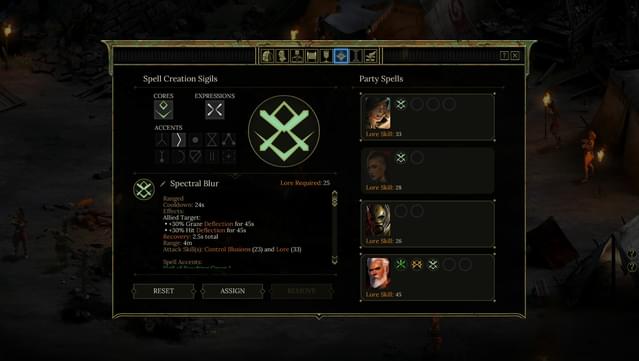
The abilities mentioned above are generally called talents (told you I'll get back to this ;)) and work somewhat similar to their equivalents in "Dragon Age" or "Mass Effect" series: most seem combat oriented and after use have a certain cooldown time before you can implement them once more. Some are area of effect, others concentrate on a single target. Every now and than (when you gain a level most commonly) you can get a new one, but some have requirements you need to meet. In that regard, they work the same as skill trees in later entires of Diablo series. Some are passive, some enhanced a talent you already posses etc. Again, discovering them all (as some groups of talents are dependable on the skills you picked at the start) is something that will require much time.
Conversations are also important part of the game and are done in a similar manner as those in "Pillars..."; your response option depend on various factors - your reputation with the factions, level of your skills and abilities, your origins. There's a lot of reading involved (think "Planescape: Torment" and "Pillars of Eternity" level), so if you generally prefer all-present voice acting (like in "Mass Effect" series for one), this will certainly NOT be to your liking.
Your choices do take effect in the story - some immediately, others later on but from what I saw thus far, I dare say that most decisions you make will, eventually, come back to either aid you or bite you in the butt. This should be a fun fact that should also help the game's replay value.
Experience is gain in a peciuliar manner - see, as your level in skills raise, so does your overall level. And how does your skill raise? By actually USING them. For example - every time your use your Athletics, your expertise in that area will go up. A similar idea, from cRPGies, was used in "Dungeon Siege".
You can train is at least some of the skills (I imagine, at one point or the other, you'll find trainers for each of them), though that requires money to use and can only be done a certain number of times per overall level.
The system itself, while vast, is decently described. Mind you, I prefer such system to be intuitive (D&D based cRPGies are best examples of such) where you don't need to dwell to much into the mechanics to enjoy the gaming experience. To that end, Tyranny has a downside as there's really no going around such informantion.
I ravel in the fact that I'm given so many talents to choose from, allowing me to create a more unique character (Specializations in "Dragon Age", for example, barely gave me the feeling my character stood out in comparison), but I would wish there was less mechanics behind them.
The inventory system could also use more work; you can get used to it in time, but to me it's very unintuitive and unnecessarily complex when often you have to make several clicks just to compare two sets of equipment and the first time visiting a merchant can be a VERY confusing experience.
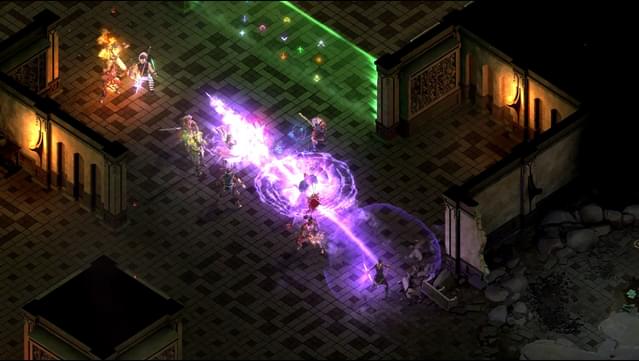
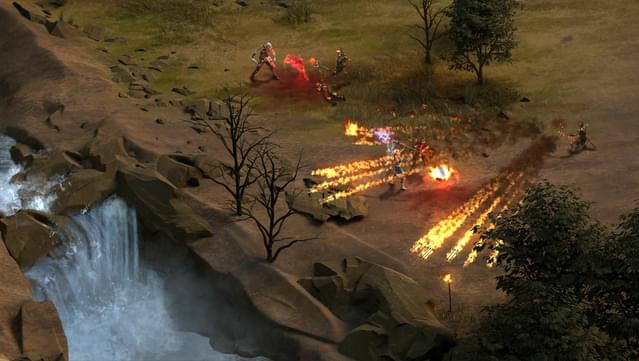
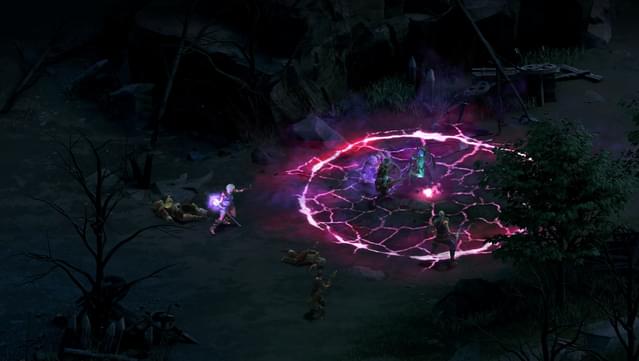
The battles are okay and those who played "Pillars" shouldn't have any trouble adjusting to it (the lack of proper tutorial for all the game mechanics is a bit of a downside here, considering how many mechanics there are... while you can just click on an enemy and leave things to fate, as in "Baldur's Gate", it is generally not advicable). Heck, I was immediately struck with realization that, when it comes to execution of that area of gameplay, they're essenatially the same game.
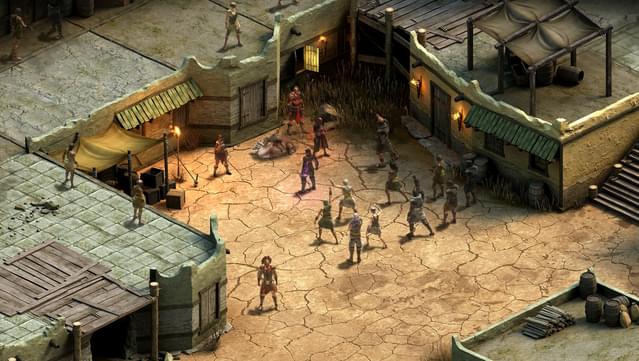
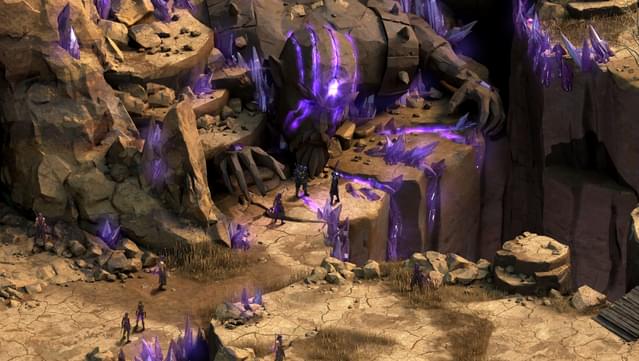
The world is crafted in detail - not just the graphics, but backstory as well. Those that like learning of the setting will find Tyranny rich in lore. Sadly, learning of it isn't done as nicely as in "Mass Effect" and resembles reading a history book. An interesting history book, but a history book none the less and not everyone might enjoy "dry facts" approach.
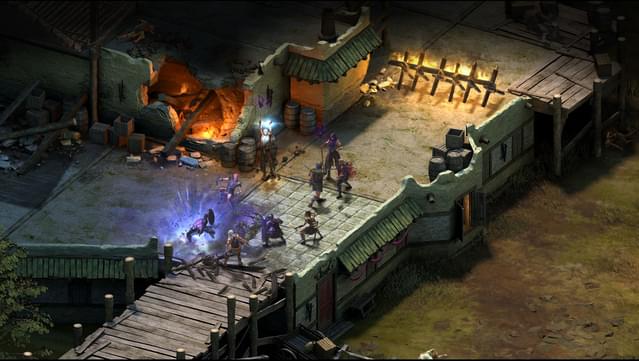
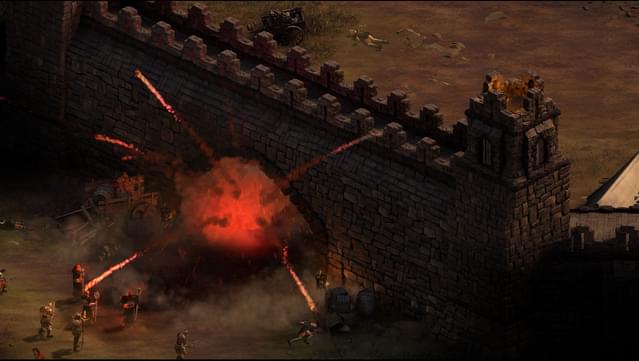
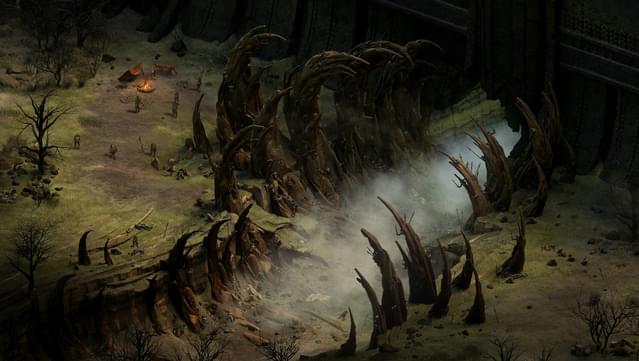
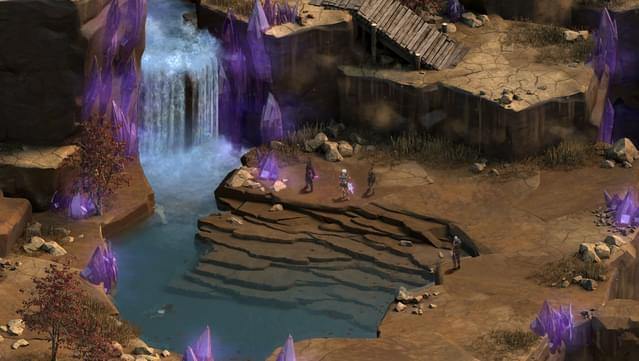
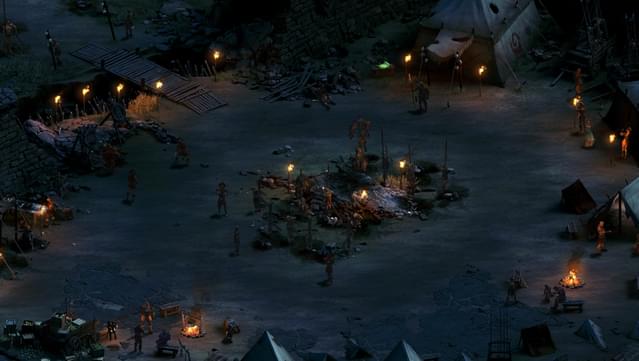
The graphics are an updated version of "old school" RPGies, much like "Pillars..." were; I imagine your opinion on that matter will be the same as it was in the previous, Obsidian title. The "cutscenes" are done in a cartoon-like graphic which may not fit the decisively dark setting of the game, but I do think they turned out marvelously and are a pleasure to watch.
Overall I believe the fans of "old school" RPGies as defined by me in the second and third paragraph of this review won't be disappointed. While I'm still not sure about free-roaming the world nor if the game has a linear plot, you can definately influence the happening before you, so this is AT LEAST "Mass Effect" level of you making your hallmark on the story.
The system is rich, if not particularly intuitive and if you like spending time in statistics, deciding what will work best for you, you'll deffinately enjoy that part of the game. Those of you that lean more towards hack&slash titles may get discouraged by this element on the other hand.
The story itself and characters are intriguing and this is coming from a guy who generally DISLIKES playing an evil character (and in this game you really can't be all good), so I'd think that's saying something. I do expect to be entertained by these, two factors as I continue my experience with Tyranny.
There are some, minor issues that held my hand from giving this game 5 stars: more than in most western RPGies I felt that this is a game (due to a massive chunk of mechanics behind the system and "dry facts" approach to lore) and had a harder time in "losing myself" in this world ("Mass Effect" series or "Planescape" presented me with no such problems). There's also a learning curve when playing for the first time... technically that should be expected in an RPG, but it felt too much, considering how much RPG I actually play (generally, I believe myself to be pretty familiar with the genre, both on PC AND pen&paper).
RPG fans, who don't mind reading (if you got through "Plansecape" without getting tired by its chunks of text than you should be fine) should enjoy this title in my opinion. Those are lean more towards action RPGies or even hack&slash should take off AT LEAST one star from the score i gave as, while there are fights (turn-based, mind you) and the system itselfs puts large emphisis on it, there's much more to be done outside of battlefield than in common action-oriented titles.
At least that's what it seems from the first, few hours I've played.
Hope this review helps all you, RPG fans in making your decision. If you require extra data, you can feel free to write me; I'll try to respond in a timely manner.
I am not a fan of CRPG. Games like Baldurs Gate, Neverwinter Nights, Pillars of Eternity and Divinity only interest me for the first 2 hours especially during the character creation. I got bored easily.
This isn't the case with Tyranny. I am not so sure why. The mechanics and gameplay are old school. But
the setting and story are fresh and immersive. I have never seen a character creation so indulging and deep that I spent about an hours not to customise the visual or the skill but to form my characters' background story. And that background story has actually obvious impact on the story as I am directly put into conflict.
With that and the fact that there are no old boring elf, orc, dwarf and mythical european midieval creatures and settings, I am pleasantly surprised especially with the fact that I bought it few days after launch. Only need a few patches to fix a long loading screen, unupdated biography screen and other tiny improvement, this game will be the gem of CRPG.
* The review is spoiler-free *
The premises of Tyranny are interesting: a game where you play the role of a morally compromised character serving an invisible, almost God-like tyrant. The settings seems to be very well-thought, the engine is the one of Pillars of Eternity, which means that it is robust and beautiful, and Obsidian is a safe bet when speaking about the quality of the writing. What could go wrong?
In fact, in the first act nothing goes wrong. The dialogue are interesting and abundant and the narration is balanced. Without going into details, the first act is about choosing your side in the war, and the way this happens made me really care about the future of my character and what could ever happen to it. And there are so many little details in the world! The worse part is, probably, the lack of enemy variety. Still, that wasn't too much of a problem for me, as I can forgive that if the story is interesting enough.
Then the second act beings. The more you go on, the more the content becomes scarce. The boring combat takes a prominent role while narration falls behind and fails to keep the pace. There are some disappointing traditional item-fetching quests, some boring battles, but still the anticipation for the things to come kept me going.
When the third and final act begins, all that sense of anticipation just fails to deliver. Things stop making sense and just "happen". There is no decent explanation, no beautiful dialogues. Every choice you have made becomes irrelevant as all of them lead you to roughly the same output. All the beautiful sense of moral responsibility that was in the first act is nowhere to be found here.
Now, for me the problem is not the abrupt ending that many have pointed out, but the fact that it does not respect my previous choices and the narration, in the end, is almost non-existent.
So, in the end, I would not recommend this game. The first act is beautiful and incredibly well-written, the other two are terribly dull.
Well I certanly didn't expect Tyranny to be as good at it is, I was waiting for it, but not raving.
I'd dare to say it's even better than Pillars, yes it's shorter and with less "options", but what it gives is nicely done, polished and presented.
Don't buy it expecting to have the next Planescape: Torment, as it's not, I see Tyranny as a nice mix of Pillars and Dragon Age: Origins, no real reason but it just struck those cords to me.
It's a highly suggested game if you like the genere.
This game is waiting for a review. Take the first shot!
{{ item.rating }}
{{ item.percentage }}%
Awaiting more reviews
An error occurred. Please try again later.
Other ratings
Awaiting more reviews
Add a review
Edit a review
Your rating:
Stars and all fields are required
Not sure what to say? Start with this:
What kept you playing?
What kind of gamer would enjoy this?
Was the game fair, tough, or just right?
What’s one feature that really stood out?
Did the game run well on your setup?
Inappropriate content. Your reviews contain bad language.
Inappropriate content. Links are not allowed.
Inappropriate content. Content contains gibberish.
Review title is too short.
Review title is too long.
Review description is too short.
Review description is too long.
Not sure what to write?
You cannot save your review due to the following reasons:
You need to select star rating
You need to enter review title
You need to enter the content of your review
Show:
5 on page
15 on page
30 on page
60 on page
Order by:
Most helpful
Most positive
Most critical
Most recent
Filters:
No reviews matching your criteria
Written in
English
Deutsch
polski
français
русский
中文(简体)
Others
Written by
Verified ownersOthers
Added
Last 30 daysLast 90 daysLast 6 monthsWheneverAfter releaseDuring Early Access
Your review should focus on your in-game experience only. Let the game stand entirely on its own merits.
Avoid noise
To discuss topics such as news, pricing, or community, use our forums. To request new games and website or GOG GALAXY features, use the community wishlist. To get technical support for your game contact our support team.
Critique responsibly
To keep our review sections clean and helpful, we will remove any reviews that break these guidelines or our terms of use.
Ok, got it
GOG Patrons who helped preserve this game
Error loading patrons. Please refresh the page and try again.