Has everything you might want except fun
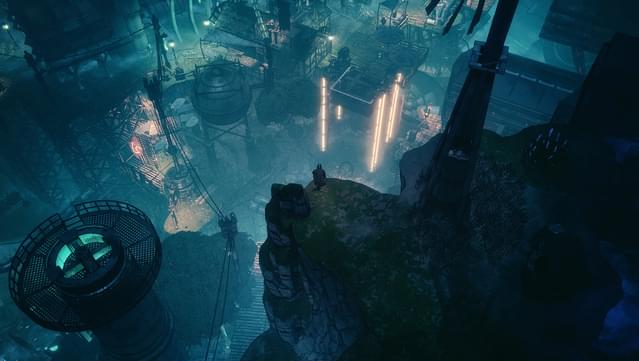
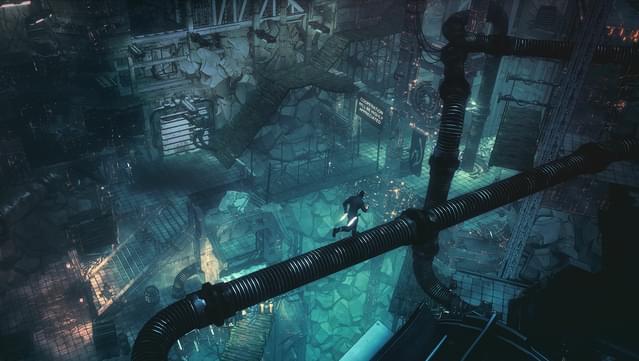
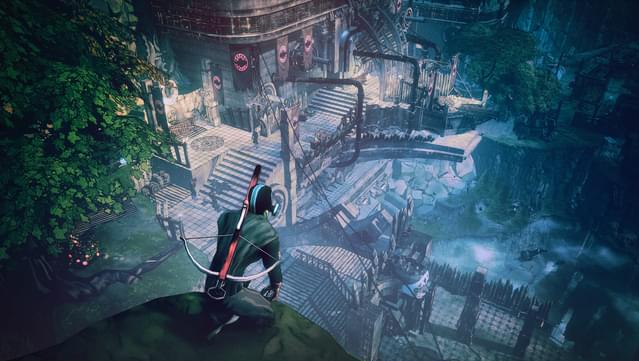
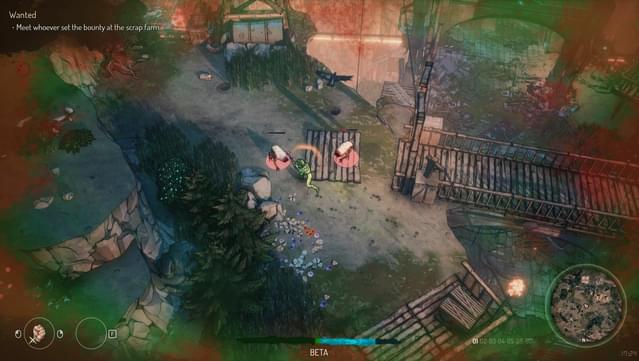
A stealth-first isometric quasi-platformer RPG in a unique setting ticks all the boxes for me. For the first couple of hours, I was drawn in by the worldbuilding, stylized cell-shaded graphics (notable for aging well, despite being a UE3 game), and unrestricted freedom of climbing anywhere and everywhere. It is only after exploring the first area I started to realize that I am not enjoying the game to a degree I should, and that it caused by annoyances so clear I can't fathom the game got released in this state.
Time and again, Seven feels like it was designed on paper with a checklist in hand, and then built without proper play testing and required iterations. Aside from occasional, not infrequent but bening crashes, I did not experience any technical issues, or even broken quests (which could easily be a problem, given the game's free-form nature). Every implemented mechanic works, but simply does not translate to fun gameplay.
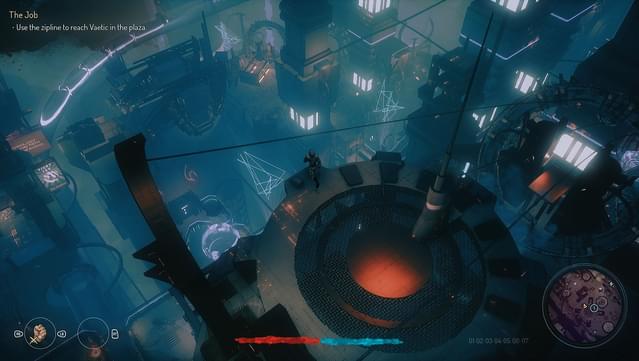
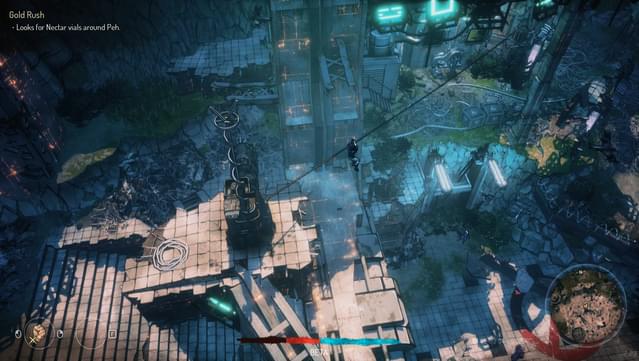
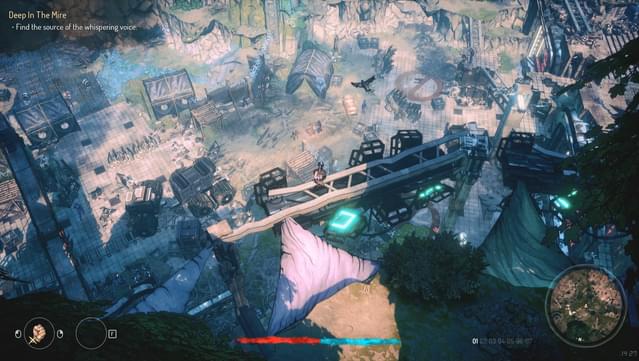
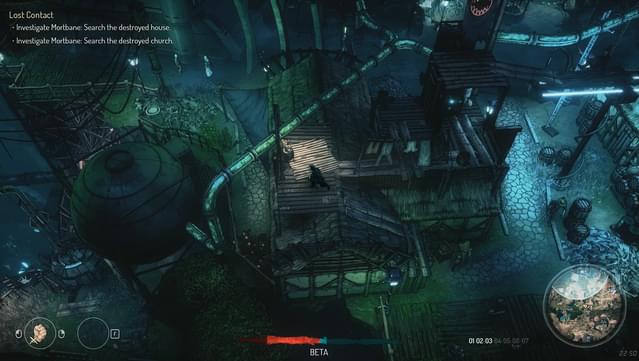
The level design is stellar: the world is a veritable three-dimensional maze in which simply going into the general direction of your objective on the map rarely will get you to your destination. There is huge verticality to it, so you will often find yourself literally on top of an icon on your 2d map and still be unable to see or even have an idea where the object you are looking for is or how to get to it. This will immediately annoy a lot of people, but for me this puzzle was actually the primary source of enjoyment. Fast travel is very limited - only between certain locations, and you need to unlock the rail lines separately. Zip lines serve to link otherwise distant points and offer fast shortcuts, and would otherwise be a great mechanic for driving exploration, but they aren't marked on the map, you never see where they will take you, and are one way only, which makes them almost useless unless you already know the way by heart. Exploration is additionally marred by the forced isometric perspective - you can rotate the camera as well as slightly move it in the horizontal plane, but cannot control its angle. The game wants you to find a climbing route on a mountain you can't see. In some cases, areas can be accessed only from one or two points, and they aren't marked on the map in any way. Even worse, the algorithm which peals away layers obstructing the view of Teriel make it impossible to see if there is a ceiling above him, and removes whole walls without any hint of their existence, leaving the player with no way of determining if there is a path in a given direction other than repeatedly bumping into invisible obstacles.
There are countless chests, boxes and caches with loot for you to steal everywhere, but 99.9% of it is literal junk, and 0.09% just consumables. The junk is useful for crafting, which is the primary system by which you improve your stats: the loot you find is almost the same throughout the game, as the open world nature means you can technically go almost anywhere almost immediately. This means that there is little point and zero excitement to looting, as there aren't any cool gear to find. Instead, most of the improvement comes from crafting, which requires acquiring schematics for upgrades and the specific kind of junk among many variations, as well as substantial amount of primary materials. It's very boring, but it could work just fine, if not for a very low weight limit on your inventory. If you want to carry several weapons (for example, at least one melee + an energy rifle + a bow/crossbow), several outfits (as disguises for various restricted areas), some consumables, especially relatively heavy traps and grenades, you quickly become overburdened to the point of immobilization with zero place left for junk you might find useful later.
If you want to craft a particular upgrade (lets say increasing the inventory capacity), you are thus forced to hunt for a particular rare drop, or trek to a merchant and hope they happen to have enough stock. Some quests, however, rely on you finding some items, as does the best ending of the game, so the game punishes you for not engaging in an extremely boring mechanic.
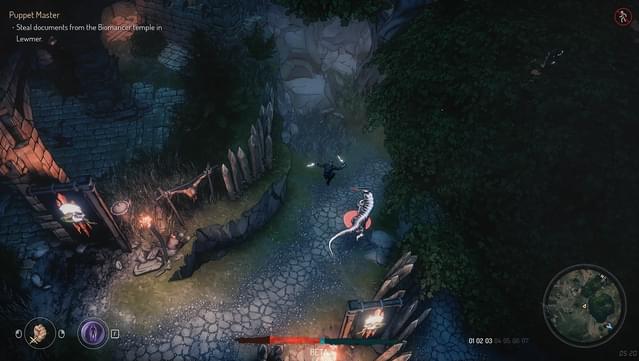
There are several weapon types and the differences aren't cosmetic, but the differences aren't properly explained. There are some advanced combat techniques like throws, finishers, drop kills, but the game never explains how to execute them. The combat is sluggish, with long and wide swing animations, which make it very hard to control positioning and facing, reducing it to little more than button mashing when facing several opponents. It is extremely easy to fall off or be thrown from a cliff, and you are never far from one. Other than being not fun, combat is also ubiquitous - even when prioritizing stealth, it is impossible to sneak past a lot of animals or larger enemy groups, and the enemies respawn regularly.
While stealth is a major mechanic, with sound, line of sight, aggro, and hiding spots all featuring prominently, the enemies move largely randomly without exact patrol routes, and it is impossible to be sure if a space is safe or not, making the experience much less polished and satisfying than in real time tactics games like Commandos and its successors. It is less about observation and careful planning and more about crossing your fingers and hoping for the best, with the invisibility ability as a last resort. There is often an alternative in having the proper outfit to reduce the suspicion, but it requires swapping one by one every clothing item, as well as carrying several suits, which easily translate to half of your carrying capacity, so it is too inconvenient to use.
The worst part, the one that makes me angry at the developers, is that all of these problems are both obvious and fixable. The game world is actually fairly large; 25% of the content could be easily cut from the game without hurting the experience, which would likely free more than enough of resources to make the game much better. The second worst part is that the game succeeds in seemingly more difficult areas, which changes the overall expression from mediocre jank to a missed opportunity. The unique blend of genres and mechanics actually works well, climb anything design is a lot of fun, the level design and world building are great, voice acting is top notch, and while the game's focus is not on narration, what there is is quite engaging.
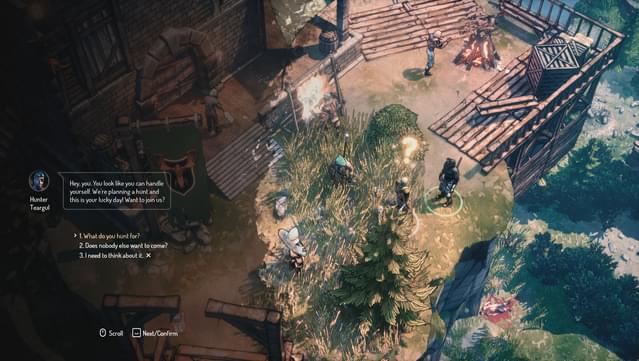
Post apocalyptic neo-medievalism with ancient technology as magic is nothing new, and neither is setting an RPG in a penal colony, but Seven manages to inject enough of unique traits to make the world feel real and alive with fairly little detail. While the glossary has expanded entries for all world information, it is more for reference than anything, and reading it is absolutely unnecessary to follow the plot or understand the world. There are no lore dumps, no lengthy dialogue, with all narration happening through natural exposition. For a game whose focus is not on narration, the story was still engaging enough for me to pay attention and want to learn about both the future and the past of this world.
From what I see, my impressions are quite in line with the consensus, which amplifies the regret of the game not being better. For some people, the flaws only detracted from the experience, without ruining it. The game is regularly on 90% discount, so if a stealth isometric parkour combination speaks to you, I would cautiously recommend trying it yourself, and perhaps speeding through the main story line with few side quests to prevent it from getting stale. However, if the idea of a sandbox for you to traverse has no appeal in itself, it is a safe pass.
Is this helpful to you?
Yes No
Report abuse