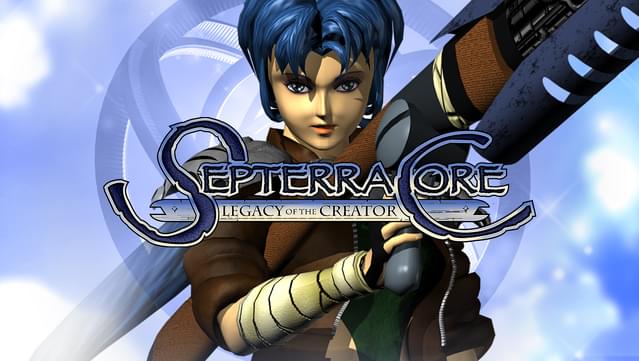
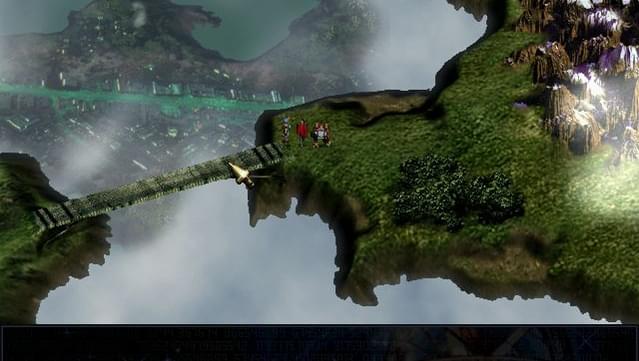
At the very heart of Septerra lies the Core, a huge Biocomputer. Seven continents at different elevations, each with its own unique people and culture, orbit around the Core.
According to an ancient prophecy, Septerra's continents will one day converge and join in orbit together on one level - this...
At the very heart of Septerra lies the Core, a huge Biocomputer. Seven continents at different elevations, each with its own unique people and culture, orbit around the Core.
According to an ancient prophecy, Septerra's continents will one day converge and join in orbit together on one level - this is the Legacy of Marduk, the Creator's son. The Chosen, fanatical believers in the supremacy of their own wisdom and technology, impatiently try to force the issue - causing a global catastrophe which threatens the lives of all Septerreans.
Meanwhile, amongst the Junkers, a young woman named Maya gets caught up in the developing maelstrom and soon finds herself confronted by seemingly insurmountable problems. Without help she stands no chance of fulfilling the Prophesy before Septerra perishes. But whom can she trust in a world torn by war and treacherous intrigue - a world on the edge of the abyss?
FEATURES:
A fantasy role playing game with over 140 characters and a complex, multi-level world
Intriguingly varied story-line
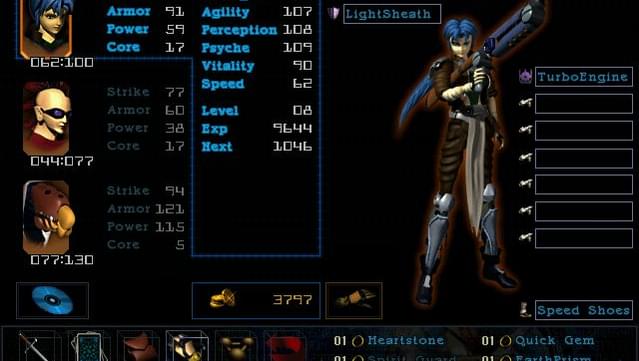
Choose up to nine party members, each with a unique motivation, skills and background
The strategic combat system combines the best of turn-based and real-time elements
Explore over 200 locations with mysterious buildings, landscapes, danger and surprise at every turn
The Adventure-style user interface gives you maximum interaction
Hundreds of entertaining voices spoken by professional actors
Copyright 1998-2013 by TopWare Interactive AG. All rights reserved.
Septerra Core, TopWare Interactive and the related logos are trademarks and/or registered trademarks of TopWare Interactive AG.
Goodies
Contents
Standard Edition
Digital Deluxe Edition with Soundtrack
manual (36 pages)
avatars
maps
artworks
HD wallpapers
artbook
Magic Cards
walkthrough
Cheats
soundtrack (mp3)
System requirements
Minimum system requirements:
Recommended system requirements:
Recommended system requirements:
Why buy on GOG.COM?
DRM FREE. No activation or online connection required to play.
This is one of those games that I look back on with longing. Whereas modern JRPG's (Not that this is made in Japan, but it shares some design similarities) feature unlikeable cliche characters, poor voice acting, and writing that makes 'Twilight' look good, this game is more reminiscent of the SNES greats like Chrono Trigger and FF6. A world with fascinating design and well-developed history, a cast of diverse and enjoyable characters, clever writing, wonderful voice acting, and an epic story, all make this game more than worth the $5.99.
Play it, love it.
This game and I go way back. When I was in the Marine Corps sometimes I would sneek my copy out in the feild and install it on one of my laptops. I played this game so much, but I never beat it. It's a testiment to the games design that most of my platoon actually ended up playing the game as well. A great old school rpg with just enough JRPG and WRPG mixture to keep things intersting.
I remember this from back when I got it, through a mail order company, which also gave me System Shock 2.
Although not as fantastic as SS2, this game suffered the same fate, it is a great game no one ever heard about.
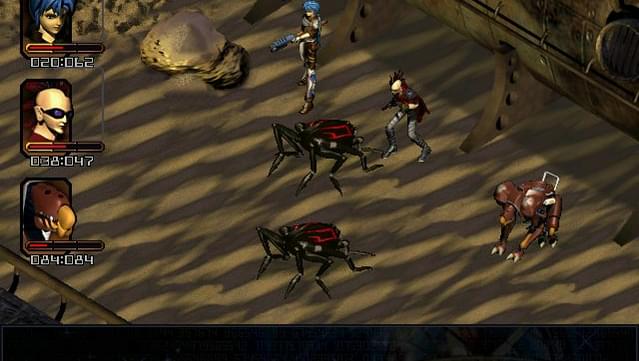
The battle mechanic is "fixed" battles, where your party, and the enemy is set in certain positions. Your partymembers will have different skills that hits in different ways, like all enemies in a row, or withing a certain angle. Your party will be made up by people from different sides/layers of the community. An interesting angle here is that members of your party recruited from different sides of the in-game conflicts might attack each other during battles..
I remember that the game had a good story, intertwined with politics, religion etc. It also has great FMV's (for the time, at least). I think I found the voice cting quite impressive for the time, this being the first RPG, with full (?) voice acting. On the negative side, the battles can, as with all RPG's become a little repeating..
So if you want a fun RPG, with some interesting bells and whistles, this one can easily be recommended!
Septerra Core: Legacy of the creator is a fine game for killing time (there's 40-60 hours of play in this thing, at least), but it's not as fun as it could be. The story is good but not great, the gameplay can be kind of confusing at times, and the combat can be kind of slow. It's a fine game for RPG lovers, but it's not an outstanding example of the genre or an especially good game unto itself.
STORY (4/5): The story of this game is a pretty good one, all things considered. The setting is unique and interesting, and the basis of the plot is pretty good; you control Maya, a salvager ("Junker") from the second shell of Septerra, and you along with your friends get pulled into a conflict between the Chosen People of the first shell and the rest of Septerra. If you can resist a knee-jerk reaction to all the religious philosophy that pervades the game, it's quite good. The reason why the story section doesn't get a 5 is because while it is generally good, chapter to chapter, the connections between chapters can be kind of weak. Often, I found myself exploring blindly across Septerra's varied landscapes, looking for a clue about what I needed to do next, but there will be more on that in the Gamplay section.
SOUNDS (3/5): The music of this game is very limited. There are seven different overworld map themes, but since you spend most of the game running around in towns or dungeons, you don't get to listen to those tunes much. Instead, you get combat music and the ambient background noise. The combat music gets old after you've heard it for the thousandth time. The music itself is generally pretty good, but the way the game is set up, you probably won't have the luxury of appreciating that detail.
The game is fully voice-acted, with a variable degree of quality. I've heard some great voice-acting in my time, and also some absolutely terrible acting; this game falls in the middle. The characters are great when they're making sarcastic remarks or giving descriptions of objects you find on Septerra, but mostly they don't do an especially good job of conveying strong emotions. Plus, in my version of the game, there was a persistant glitch that would cause short sentences spoken by the characters to be cut off; the game's written dialogue always runs at the same pace as the voice-acting, so in some cases there's no time to read what the characters say before the textbox moves to the next character.
Other sounds are unremarkable.
VISUALS (4/5): This game is pretty, given the time of its making. That said, the quality of the animations seems to vary depending on a variety of factors.
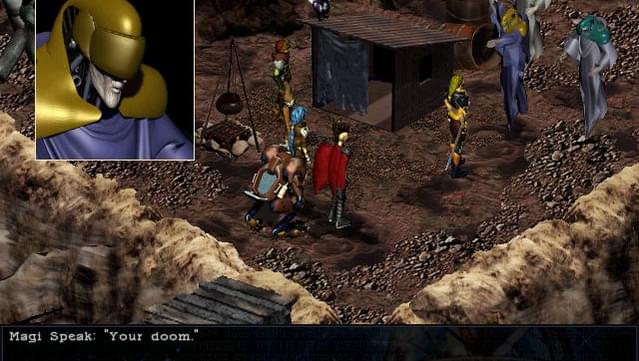
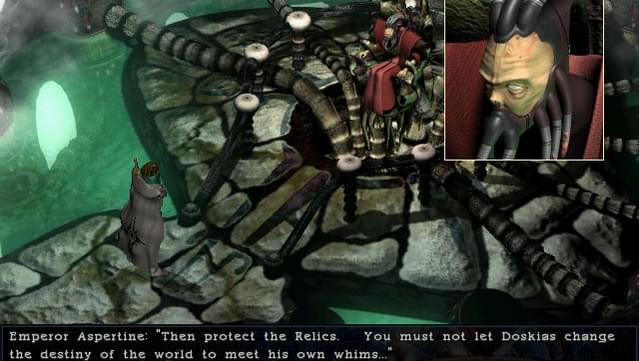
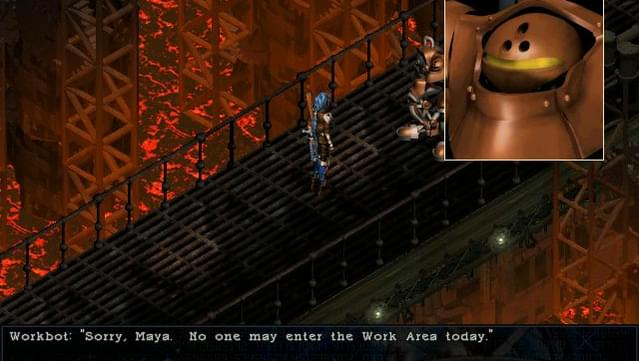
When your characters are conversing and it isn't an FMV cutscene, little talking heads pop up to accompany the dialogue. I thought these heads were fairly expressive emotionally and generally well-done.
When your characters are just wandering around on the map, their animations are limited and not very fluid. It looks better than a 16-bit game, but not by very much.
The few FMV scenes are often kind of ugly and also seem to be unnecessarily dark. I felt, during the game, that the designers much have done better to somehow render the cutscenes into the game itself instead of breaking the flow with FMVs.
GAMEPLAY (2/5): The combat is boring. B-O-R-I-N-G. It's very slow, there's no way to speed up the animations, and in battles which feature six enemies or more (which is almost all of them), it can take an arbitrarily long time to kill enemies who aren't seriously dangerous unless you just sit there and let them hit you. Even then, it would generally take them at least ten minutes to kill you.
Another reviewer complained that this is a bad game for a mage. This is true for most of the game, but in the endgame, magic becomes the fast solution to every problem. As long as you have enough Core-restoring items, any and all enemies can be destroyed in under 20 seconds using one or two spells. This is also boring, but at least it's faster than being shot at 3-4 times while waitng for your Endurance meter to charge up, unleashing one attack, and then repeating the process until everyone dies. Most of the time, magic is used as a weapon against you that you cannot effectively counter, making battles longer and harder without giving any extra rewards.
The dungeons are generally not very interesting. They look great, but they generally only come in the forms of:
A) Roughly linear tunnels full of monsters.
B) Looping tunnels full of locked doors and levers that open locked doors.
C) Looping tunnels full of locked doors, levers that open locked doors, and keys to other locked doors.
.... and they get progressively larger as the game progresses, so that by the end of the game you become absolutely dependent on your map in order to avoid getting lost in the enormous dungeon-sprawl.
On top of that, there are several sections of the game that seem to mimic an adventure game in a bad way. You get presented with a puzzle, usually in the form of a locked door, that you can only open with a certain combination of items. You need to be exceptionally attentive in order to notice every item you need and know how to use it. Your characters can give you limited hints if you click on the right things, but by and large you're left with no real guidance. Sometimes this can be very frustrating, because if you fail to notice a particular piece of scenery and examine it with the right character, you may never find a solution to your problems.
OVERALL (3/5): This isn't going to join the list of my favorite games anytime soon. It's interesting for its setting and plot, but not much else. If you want a game that you can play for weeks, this is an okay one; however, you'll be spending most of that playtime fighting needlessly long battles and marching through oversized dungeon environments.
I'm serious about the laggy combat. I got into the habit of bringing a book to read between combat rounds.
Septerra Core is an attractive, easy-to-play JRPG-style adventure with a nice interface, a good story in a surprisingly deep world, and a neat magic system. It has some of the feel of a console RPG but was developed solely for the PC, totally avoiding awkward interface elements in favor of intuitive point-and-click. It's not particularly challenging, it's very linear, and it can be slow, but it's fun to experience the world of Septerra.
This is a game to play for the story and atmosphere, or if you're a fan of classic JRPGs; this is not my usual cup of tea, but it ended up being a nice change of pace for me and managed to pull me out of my usual challenge-focused mindset.
VISUALS and AUDIO:
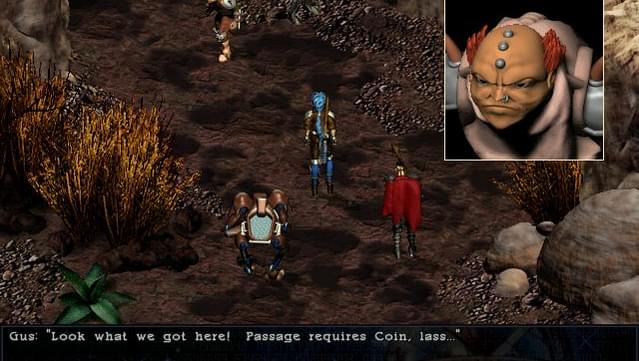
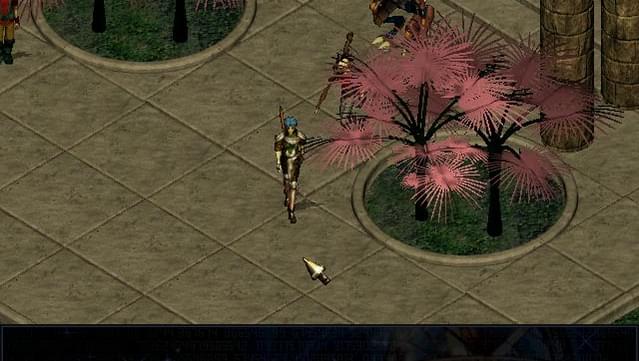
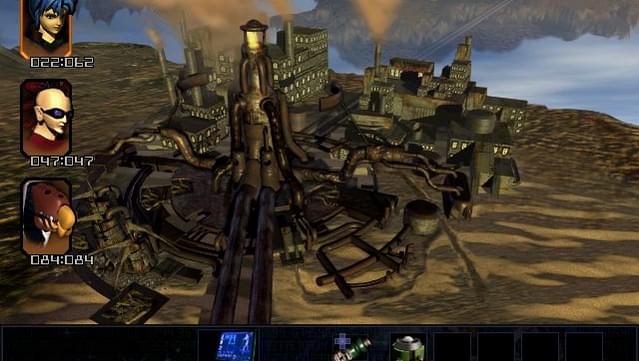
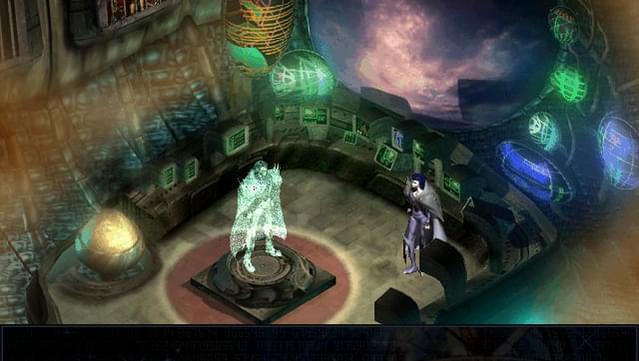
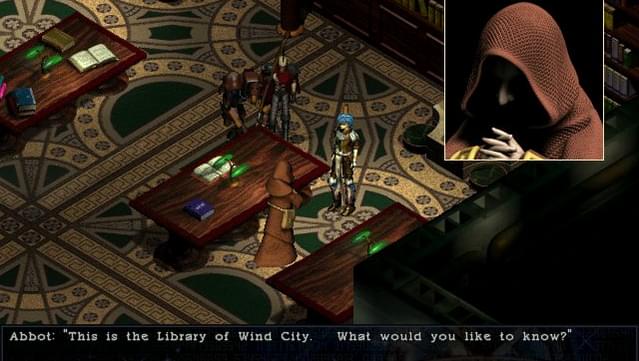
The game runs at a low fixed resolution and is entirely composed of pre-rendered 3D scenes and sprites, but it looks surprisingly good. There are enough frames of animation and different facing angles that the fact that it's pre-rendered isn't a problem. Local lighting in scenes affects the characters, and there are even shadows that shift as you move about. Your view is centered on your main character and scrolls as you move around the map, sometimes panning to take in a point of interest. Each map is a big painted/rendered picture, so scenery is wonderfully varied, geometry is tremendously flexible (particularly with multi-level scenes), and since you are smoothly scrolling through it even as you move between levels, it doesn't feel static at all.
Combat animations are flashy, detailed, and clearly indicate what is happening (but they're slow). In dialog, talking heads pop up, and while they are simply-textured and not well lip-synched, these are surprisingly emotive. World maps are quite pretty, and some scenes have a more horizontal viewpoint with well-painted background vistas. I was somewhat startled when I started sorting screenshots and realized how low the resolution actually was (640x480) - it doesn't seem that low in-game.
The game generally sounds good too - there isn't much scene music (mainly on the world maps, each with its own well-done theme), but the ambient sound for each location is well done. It is natural enough that at times you don't notice it much, but silent (or near-silent) areas are notable. There are plenty of sound-generating objects and wildlife that you hear when you are nearby, but enemies do not make sounds (maps do have native-enemy sounds at random, some of which are positional but indicate nothing). Battles are backed by music randomly chosen from a small list, but it never got irritating, so it's decently done (and can be turned off). Some combat sounds are consistently mis-timed, but this is apparently a computer-specific issue.
STORY/ACTING:
Despite a JRPG/anime-cliche quasi-Christian-mythology framing story, the game storyline is actually quite good. This is in large part due to a tremendous amount of NPC interaction and full voice acting for everything. Every NPC wandering through every town can be talked to, with plenty who are just there for flavor - and they interact differently with each of your 8 possible companions, sometimes very amusingly so (bring Led and Selina around towns!). The voice acting is solid; it sounds like the actors actually know what's going on, so conversations are pretty natural. The surprisingly nuanced emotional range of the animated talking heads really adds to the effect. The only thing I can say against the acting is that with so many characters, there is inevitable re-use of some voices for minor NPCs, and a limited number of head models (although they do vary in palette and generally match the voice) for same. This is really a quibble, since all the major characters have unique voices and faces. There are a couple of dramatic moments in the FMVs where the acting isn't quite up to snuff, but nobody's perfect.
The world in which the game is set is very original and plays an integral part in the overall plot. The varying cultures among the 7 shells are well-expressed, and significant changes are wrought on the physical, political, and cultural landscape in the course of the story, lending events and your missions some real weight.
CONTROLS and GAMEPLAY:
Everything is point-and-click (although there are keyboard shortcuts for many things). You control Maya, and your two companions (who can be swapped out at various "home base" locations) follow. You interact by clicking or by clicking an item from your inventory (helpfully sorted into restoratives and "key items") and then a target on which to use it. When talking, you choose a party member to speak, or select among available topics of conversation presented as pictures; there is no branching or reply selection, so everything is simple. Whenever you are hovering over an item, a name and description will be displayed; if it is equipment, altered stats will show in green (improved) or red (reduced). Everything is pretty intuitive and response is very snappy.
The interface is clean, well-designed, and large - items are clearly identifiable (in the inventory, as a pointer icon, or on the ground), and the game manages to avoid having too many things on screen at once while also avoiding menu interfaces - large, friendly icons and action panels keep the flow smooth. Inventory management is assisted by handy highlights on portraits of those who can equip items (in stores), or by showing only what is usable in a particular slot (when equipping). The only complaint I have is that the lovely large portraits can sometimes cover damage messages in combat (and status for enemies near the bottom or top of the screen is similarly cut off).
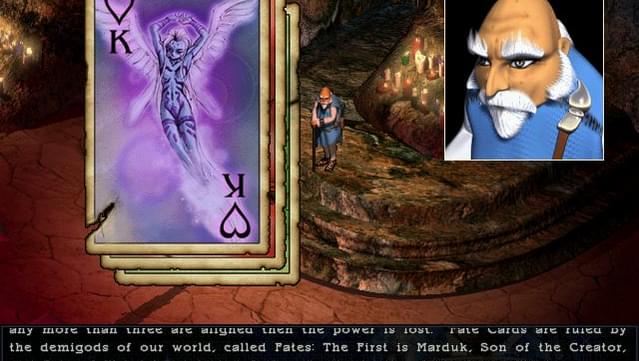
Combat is similarly straightforward, although there are more options. Your characters charge up action bars (based on a speed stat), which allow them to attack with 3 levels of increasing strength or use advanced abilities (equipment and level gain eventually grant 6 special abilities to each character in addition to the three basic attacks), the latter of which cost energy. That energy can also be used to cast spells, which are assembled from "fate cards" earned over the course of the game; more powerful spells can be assembled by combining cards (with multiple characters). In addition to being a fun concept, the big drag-and-drop cards avoid tedious menu reading, and the cards sort themselves according to what can be combined with current selections (and energy levels), speeding up spell assembly considerably. Major spells (particularly summons) have rather elaborate casting scenes, which are cool but become a tad irritating over time due to their length. Some abilities will hit enemies in a line or based on distance to the primary target, so positioning matters (but it is fixed for each combat and you cannot move). The system will be generally familiar to fans of JRPG-style games, although it nicely avoids the immersion-breaking menu-trees (it does have similarly slow combat and long attack animations though).
Enemies respawn when you exit a map and return, although a few are only encountered once (and major in-game events can change map contents); they are always the same, which lets you blaze through sections old maps to which you must occasionally return. Exploration is rewarded with barrels and crates of goodies (plus XP, gold, and items from combat), but these do not re-spawn, so you can take short return paths. Enemies patrol the map and can sometimes be dodged by deft navigation and timing, which is a nice touch. There is a decent variety of enemy types with different characteristics and behaviors, and as they level up they gain new abilities along with their better stats, so things stay interesting for a fair while.
There are a number of "boss fights" that range from particularly tough enemies/teams with unpleasant new spells to more puzzle-type bosses, generally of the "hit this [thing that does not show a damage number] n times to expose vulnerable bits, smack hard, repeat" variety, but sometimes more complex. Some regenerate parts and require coordinated elimination, and some are ridiculously resistant to normal attack (and/or harshly punish direct assault) but can be fought much more effectively in an indirect manner. Gratifyingly, the latter *can* be destroyed via the painful and unwise direct route, even if it does require a long time and a lot of restoratives - this just feels a little more fair, even if you decide to go back and re-fight using the trick you figured out at the end to save items (*whistles innocently*).
DIFFICULTY:
While you are likely to die a few times (particularly to bad luck in the early game, and to surprising new enemy abilities in the midgame), games of this type really can't be particularly hard. At the beginning of the game it takes a bit of time to build up funds for decent gear, but you'll get through with careful use of free home-base healing and a habit of checking your healing stocks before moving forward to a new map. Eventually you'll be able to kit out most of your party, and as you advance in levels and available gear, the cost of healing and energy-restoring items becomes so relatively small that you can afford to always be well-stocked. A bit of exploration will provide helpful extras [and the fact that characters revive with 1 HP after combat means that you need not spend expensive revivers except in dire circumstances], and combat rewards will pad your supplies nicely. By the mid-game you should be able to buy nearly everyone the best new gear every time shops upgrade their offerings, and top up your core runes (at this point, healing via spell is cheaper than bread, so no need to buy healing items) before every mission. If you're decently prepared and make reasonable tactical choices in combat, "hard fight" will generally mean "I had to use healing" rather than "I died". Bosses might take a few tries, and you're still susceptible to exceptional strings of bad luck, but with non-random enemies and quicksave-anywhere, it's just a few minutes wasted.
The game also suffers from power-curve issues that are all but unavoidable in games without detailed battlefield tactics - by the endgame, you have strong casters, spells that can hit everything, and the funds to buy a huge pile of energy-restoring items. Normal fights can be blazed through by firing high-power spells, bosses generally just require a few defense spells or debuffs like Slow to start, and puzzle bosses are simply a matter of waiting or the right sequence of attacks. All that said, it's still reasonably fun, and your variety of available spells allows a bit of tactical variation in boss fights.
LEVELS, STRATEGY, and OTHER ELEMENTS:
Generally, level design is pretty good - thanks to a fully-visible map (which unfortunately stretches oddly to fill the screen), you can generally see where you need to go, although you may need to search for a switch. Some levels look like mazes and require exploration of many long cul-de-sacs, but thanks to well-placed doors require very little backtracking (some of the Palace and the Core Mines are good examples), but a few (the prison) do get a bit tedious. The game pans to show you every map change caused by a switch, which helps make puzzle maps much less irritating in addition to sometimes revealing hidden goodies. Early on, you will have to cross through repopulated combat zones going to and from objectives, but switches stay flipped, so return trips are generally much shorter.
A few bosses and high-level areas are accessible significantly before they are important to the plot, so if you are having way too much trouble, step back and consider whether you need to be doing this now. If you haven't been told about something or instructed to go here, you probably can come back later; if you're lost, go talk to Azziz and Layla about everything for hints. All that said, I was able to beat <the thing that makes a problematic noise> when I found it (great fun, although it took a long time), and the reward was useful!
Equipment decisions are generally easy, as there is usually a best item available at any given time for each slot, although body armor often has a heavy vs light choice (almost always go light, speed kills enemies). This keeps life simple and avoids excessive inventory management, but the more flexible "optional item" slot lets you customize your characters a bit. I didn't find protection items very helpful, usually opting for stat-increasers (killing enemies faster also reduces damage taken!).
A few tips: character speed matters quite a bit - Dog has great power, but he's so slow that his damage output is actually quite poor, and his low agility means that he misses a LOT. Badu suffers the same problem, although not nearly as badly (and it is only in the late game that his miss percentage skyrockets). Led is an excellent companion because she is a mechanic, fast, has anti-robot powers, is a very strong caster, and does acceptable damage (plus she is agile enough to sometimes hit cloaked enemies, great in the midgame). Characters that hate others will sometimes attack them in combat, but all such pairs can be reconciled in side missions that will be clear if you pay attention to what people say. Advanced character abilities (the ones acquired late in the game) are generally not worth the action points and core cost - spells will do far more for less. Relatedly, once Heal gives about 50 health, it is cheaper to use (via core rune replenishment) than bread; in the late game Heal+All trumps all items except in combat emergencies. If you aren't strong enough to take out undead with normal attacks before they get to you, Fire+All is probably cheaper than healing (similarly with anything else that has huge damage resistance and strong attacks, including werewolves, skulls [use water], and robots [lightning]), not to mention safer and way faster.
THE VERDICT:
I definitely had fun with Septerra Core, and it has a lovely world in which to play. It looks and sounds good, and the acting carries the story well. It is also seriously long - the first time I thought I was nearing the finale turned out to be only about 2/3 of the way through! Unfortunately, combat is slow, inevitable power curve issues that make the late game kind of boring, and a some of the levels depart from the overall good design and get a bit tedious.
The linearity and simplicity of the game that make it completely non-frustrating to play also handicap the game rating-wise; on the other hand, the power-curve problems let me blaze through the last few missions using my fastest attack, reducing the potential tedium. In the end, it was a nice change of pace for me, a fun story in which to participate, and the presentation and acting edge it into 4-star territory.
This game is waiting for a review. Take the first shot!
{{ item.rating }}
{{ item.percentage }}%
Awaiting more reviews
An error occurred. Please try again later.
Other ratings
Awaiting more reviews
Add a review
Edit a review
Your rating:
Stars and all fields are required
Not sure what to say? Start with this:
What kept you playing?
What kind of gamer would enjoy this?
Was the game fair, tough, or just right?
What’s one feature that really stood out?
Did the game run well on your setup?
Inappropriate content. Your reviews contain bad language.
Inappropriate content. Links are not allowed.
Inappropriate content. Content contains gibberish.
Review title is too short.
Review title is too long.
Review description is too short.
Review description is too long.
Not sure what to write?
You cannot save your review due to the following reasons:
You need to select star rating
You need to enter review title
You need to enter the content of your review
Show:
5 on page
15 on page
30 on page
60 on page
Order by:
Most helpful
Most positive
Most critical
Most recent
Filters:
No reviews matching your criteria
Written in
English
Deutsch
polski
français
русский
中文(简体)
Others
Written by
Verified ownersOthers
Added
Last 30 daysLast 90 daysLast 6 monthsWheneverAfter releaseDuring Early Access
Your review should focus on your in-game experience only. Let the game stand entirely on its own merits.
Avoid noise
To discuss topics such as news, pricing, or community, use our forums. To request new games and website or GOG GALAXY features, use the community wishlist. To get technical support for your game contact our support team.
Critique responsibly
To keep our review sections clean and helpful, we will remove any reviews that break these guidelines or our terms of use.
Ok, got it
GOG Patrons who helped preserve this game
Error loading patrons. Please refresh the page and try again.